One More Serial Number Fun Post

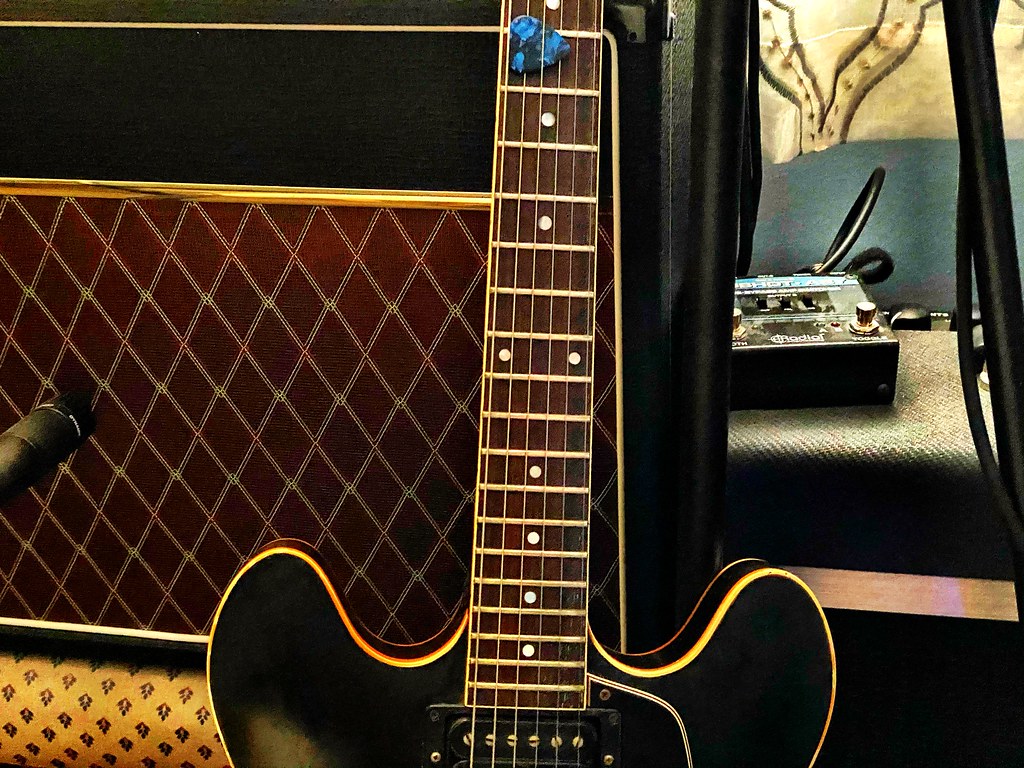
My Gibson ES-335 Pro was the 127th guitar stamped in Kalamazoo on Wednesday December 5, 1979.

My Gibson SG Standard doesn’t follow the same serial number method as my two 70’s Gibsons.  There is much less to play with now as the first two digits are the model year (not necessarily the year the guitar was built, kinda like cars) and the remaining seven digits are just a counter for that model year.  My guitar is the 22,586th 2018 model guitar.

I never noticed it before, but there is a Made in USA stamp on my Les Paul.  My ES-335 does not have a Made in USA stamp, but it does have SECOND in it’s place.  It was a factory second, kinda like clothes were a slight defect will keep the item from passing Quality Control, but it isn’t bad enough to stop it from selling at a slight discount.  I believe my 335 is seconded because of a hole in the finish on the back of the guitar.  It’s never bothered me in the slightest.

My SG includes both a Made in USA stamp and a 2018 Model stamp.  Just in case the serial number didn’t give it away.  I bought the SG new and I have all of the case candy.  That includes a filled out QC checklist card that is dated 10/12/17… so my 2018 guitar was actually made in 2017.  It has a model number too, SGS18HC… something or other… CM1, or CH1, or something like that.  The hand writing is a little tough to make out.  They also sent a picture of my guitar sitting on the QC work bench where it was apparently plugged into a Boss tuner pedal…. I don’t like Boss pedals.  That actually makes me sad.

As for the model number, SGS is SG Standard, 18 is the model year, HC is probably hard shell case.  The rest?  I don’t know, and Google doesn’t tell me anything.

Well, that’s it for serial numbers for my electric guitars.  I suppose I could go look at my Takamine acoustic 12-string but… I don’t wanna.

Happy Friday!

More Serial Number Fun

After all the fun I had with the serial number on my Strat yesterday, I figured I’d try Googling about serial numbers on Gibson Les Pauls.  I learned a couple of things, but most of what I found I already knew.

It was just a few years prior to my guitar’s creation that Gibson switched to the eight digit serial number format.  I knew that the first digit and the fifth digit combine to form the year.  That’s how I figured out my guitar was from 1978.  I also knew that the other six digits represented the rest of the date and the production count for that day.  I didn’t quite know how though.

The pattern is this: YDDDYRRR

YY is year
DDD is the day of the year
RRR is the counter.

From that, with a little Googling to figure out what day the date counter corresponded to, I learned that my guitar was made on September 18, 1978.

So what does the counter mean?  It turns out that three digit counter is actually two counters in one.  Numbers between 1 and 499 are for guitars made in the old Kalamazoo, MI factory while numbers from 500 to 999 are for guitars made in Nashville, TN.  The actual number represents the number that was stamped that day.  So a guitar stamped with 123 was the 123rd guitar to have it’s serial number stamped on that day in Kalamazoo, where the number 623 would be the 123rd guitar to have it’s serial number stamped on that day in Nashville.

My guitar was made in Nashville.  I never knew that.  It doesn’t matter even the tiniest bit, but somehow that little fact made this whole pursuit worthwhile.

The only other outstanding question for me is, what kind of pickups did it have when it left the factory?  I bought the guitar in 1990 and neither of the pickups were stock.  In 2006 (I think), in an attempt to make the guitar sound more like a stock Les Paul, I had Larry install a set of Gibson Classic ’57’s.  Gibson was marketing those pickups as being close to the original PAF pickups that were first added to Les Pauls in 1957.  (PAF stands for Patent Applied For, and they were Gibson’s first humbuckers.  Prior to that Les Pauls had single coil P90 pickups).  It turned out that I didn’t really like the sound of the Classic ’57 in the bridge position and a few years ago I had a tech at Guitar Center swap it out for a Gibson Dirty Fingers.  I was familiar with those because they came stock in my ES-335 Pro and I love them.

But that doesn’t answer the question… what did my Les Paul originally come with?  I Googled that too and was pretty surprised to find that there is almost no definitive information online.  I did find a couple of forum posts though that said a 1978 Les Paul Custom would have come with what Gibson called “Original Humbuckers” which unfortunately is a name that they’ve used for a few different models of pickups.  To the general public though, the pickups in my guitar would have been known as T-Tops.

I don’t know anything about them except that some people like them and some people don’t, and lots of people were swapping them out for non-Gibson models anyway.  The two pickups in the guitar when I bought it were perfect examples of that.

So now I have to dig into T-Tops and see if I can score some on ebay.  Insert maniacal laughter here.


Bibliography:

I Think My Strat Might Be Rare-ish

I want to sell my Fender Stratocaster.  I never use it and I want it to find a good home.  I’m thinking of trading it in somewhere and getting a Vox amp.  It’s a nice guitar, but the more I learn about myself, the more I just don’t connect with Strats.  I’m a Gibson guy to the core.

When I first bought the guitar in 2014 I did a little tiny bit of research to find out when it was made.  I learned that serial numbers starting with Z date to after 2000, with the number immediately following the Z representing the year.  Mine starts with Z0.  That means it was made in 2000.  Nice.

The guitar is also stamped with Made in USA (I don’t think I would have bought it if it said Mexico or Japan… snob) and being an old person who doesn’t pay much attention to Fender model names, I assumed that made it a Fender American Standard Stratocaster.  That’s what they called the non-custom shop (does Fender call it custom shop? I think so) American strats the last time I paid attention.  At some point over the last six years I realized that name isn’t used anymore and it likely changed prior to my guitar’s manufacture.

So today at lunch I figured I’d play the detective game and see if I could figure out what my guitar’s model name actually is.  Google brought me to a Fender webpage where you can enter your serial number and it will register your guitar.  Well, I don’t want to register it since I don’t plan to keep it, but I looked anyway.

I entered my serial number and it gave me this:

AM STRATOCASTER MN AMM

Okay… well what the hell does that mean?  I Googled it and it only returned a few hits.  Most of them were not in English.  Two were from a thread on aguitarforum.com.  Someone bought a franken-strat and was trying to piece together where the various components came from.  He listed his serial number and someone else apparently did the same registration that I did and came back with the same results.  He gave a breakdown of what the mnemonics stand for.

AM = American
NM = Maple neck
AMM = Aqua Marine Metallic finish.

Cool!  Now I finally know what to call the weird greenish color paint job.  He also included a link to a sale page from reverb.com that included more information.  Apparently the model name American Standard was changed to American Series in 2000, and the Aqua Marine Metallic finish was introduced at the same time.  Interestingly, that finish went away in 2002.  The production run was actually June 2000 through January 2002, so only about a year and a half.  Elsewhere in the listing he also said it ran from June 2001 to January 2002 for six months… so… yeah, I’m going to believe the 2000 because Fender told me my guitar was made in 2000.

So what exactly does that mean?

If the reverb listing is to be believed, then I think I got a pretty good deal when I bought this.  I believe I paid $700, which was so low for an American strat that I assumed I would eventually find something horribly wrong with it.  The guitar pictured in the reverb listing is definitely a match for my guitar except that it doesn’t have the stock pickups.  Or, at least, it doesn’t have the same pickups I have.  The sale shows Lace Sensors which I equate to Clapton signature models from the late 80’s.  I don’t think I ever saw them stock in a guitar from the 2000’s, but like I said I don’t know Fenders well at all.  I think I got a good deal because the selling price was quite a bit higher than what I paid.

The two things that are giving me pause are,

  1. The reverb listing uses the word “rare” in the description.  In fact, it’s the first word.
  2. The selling price on the listing is more than 50% higher than what I paid for mine.  Caveat there is that I don’t believe the guitar actually sold.  It just shows the listing ended.

Two months ago I was planning to take my guitar to a shop and trade it in, fully expecting that I would get at least mildly screwed on the trade value.  I was okay with that.

Now?  Am I still okay with that?

Crud.  Knowledge is power and all, but I feel like I was happier and more confident in my ignorance.  Now I know how trump supporters feel.

Crap.


Bibliography:


All Done With That

All of my April rhythm guitar parts are done, including a bonus 11th song that I started at 3:30am today when I was too pissed off at facebook to sleep.

Untitled

I wonder… if I stop taking pictures of whatever guitar I am playing every time I play, would the world go back to normal?  Is all of this my fault somehow?

Guitar Nerd Moment, or It’s a Small World

A couple of days ago I posted a picture of one of my guitars that had a caption mentioning Eric Clapton’s “woman tone”.  I don’t think I mentioned anything about why I was thinking of that.

First, Eric Clapton in the 1960’s is a tone chasing guitarist’s role model.  Give him a Gibson guitar and a Marshal amplifier and he will make sounds that, if you are smart, you’re going to want to copy.  He was innovative and experimental and inspiring.  Eric Clapton in the 1970’s and 80’s is the exact opposite.  I don’t know of anyone who has ever listened to Money and Cigarettes and said, ooh I wanna sound like that!

Anyway, when Eric was in his 20’s he was probably a little full of himself (people called him god) and sometimes he would do things that were a little over the top.  One of those things, in my book at least, was naming one of his guitar tones.  Yup.  In 1967 while playing with Cream he used a tonal technique on the Disraeli Gears album that he called “woman tone”.  Why?  I don’t know.  It was probably something that in today’s social climate would probably sound unbelievably sexist.  I don’t know why and I don’t want to know why.

Probably the best known usage is in the guitar solo from Sunshine of Your Love, which also bears a remarkable resemblance to the melody from Strangers in the Night, but I digress:

Anyway, achieving “woman tone” is pretty simple and even a chump like me can do it.  I don’t often, but every so often the spirit of Disraeli Gears will take me and I’ll use it.  A few nights ago I was sitting in my room adding lead guitar parts to a couple of RPM songs and without realizing I was going there, I totally went there.  One eight bar (or so) solo used the ol’ “woman tone”.

Today there was a “wow, what a small world” moment for me.  That Pedal Show, the youtube show that I watch pretty religiously every week and has taught me more about making my guitar sound less shitty than any other source I’ve come across in my 34 years of playing, put out a new episode called “12 Ways to User Your Guitar’s Controls”.  One of those 12 ways to uses your guitars controls was “woman tone”.

I am using a lot of quotation marks in this post, and I am using the incorrect punctuation for all of them.  Suck it, grammar!

The “woman tone” discussion starts at 13:30 and it sounds better when Mick does it on his ES-335 than when I do it on my Les Paul.

As for the rest of the episode, I had already come up with most of the two-humbucker tricks on my own back in the 80’s.  The single coil stuff doesn’t really apply to me as I only own one guitar with single coils and if it weren’t for COVID-19 I would have sold it by now.  I use the trick with using the pickup switch and the two volume knobs to go from clean to dirty all the time, and the mixing the two pickups together thing once in a while.  The kill switch?  I drive Lizardfish nuts with that whenever the opportunity arrises.

Anyway, I just thought it was funny that I recorded a little “woman tone” this week and then saw a tutorial on using it.  It’s a small world after all.

In closing, Clapton used it on the leads on this song too.  It’s not nearly as popular a song, but it’s a personal favorite.

Day 17, aka Ooops

I just posted this on the RPM Challenge website:

I recorded some rhythm guitars last night.  Nothing special, but one of the two songs I worked on is turning out to be almost kinda fun.

This morning as I’m going through my morning routine I was actually kind of humming the riff to myself.  Nice!  That never happens!

Then… wait a second… that’s not the song I worked on last night… what is it?  Oh yeah, it’s one of my February songs.

(insert annoyed sigh here)

Looks like Robbie’s written the same song twice… again.

I really don’t care.

SG

The guitar was played tonight.

After I played through one RPM song I made Tewksbury Tweets (!!!!!!!!) while listening to Cream. If you’re wondering how Eric setup his Gibson SG to get what he uber pretentiously referred to as “woman tone”, here’s the secret: